
Good enough for our own children.
Printables grounded in peer-reviewed research — created by parents with backgrounds in scientific research and academia, and shaped by input from occupational therapists we’ve worked with over the years for our own children.
We couldn't find resources good enough for our own children. So we built them — grounded in peer-reviewed research, beautifully designed, and made for real families and real therapy rooms.
Evidence-Based Every bundle cites peer-reviewed research. No guesswork.
OT-Reviewed Reviewed by occupational therapists and child psychologists.
Instant Download PDF delivered immediately. Print or use digitally.
Find the right printable for your child or a little one below
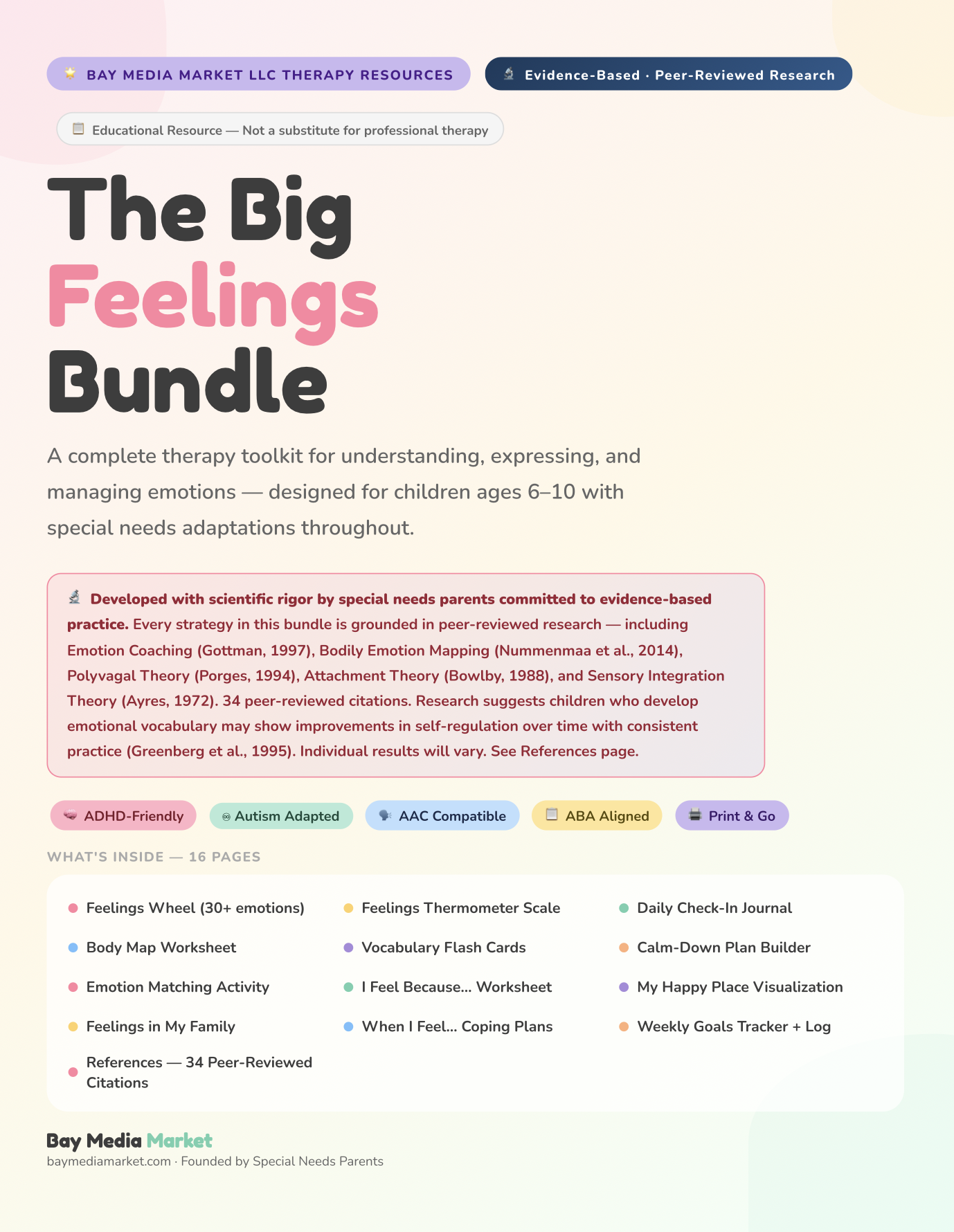
Your child's feelings are big.
Their toolkit should be too.
A complete emotional literacy and regulation toolkit for children ages 6–10.
We built this bundle because we lived it — the meltdowns with no words to describe them, the overwhelm with nowhere to put it, the moments where our children needed a tool and we had nothing to give them.
Every worksheet in this bundle is grounded in peer-reviewed research and reviewed by occupational therapists and child psychologists. It's the resource we wish we'd had from day one.
What’s Inside
16 pages covering:
Feelings identification & emotion vocabulary
My Feelings Wheel — laminate for daily use
Feelings Check-In — print one per week
Calm-Down Strategies Toolkit
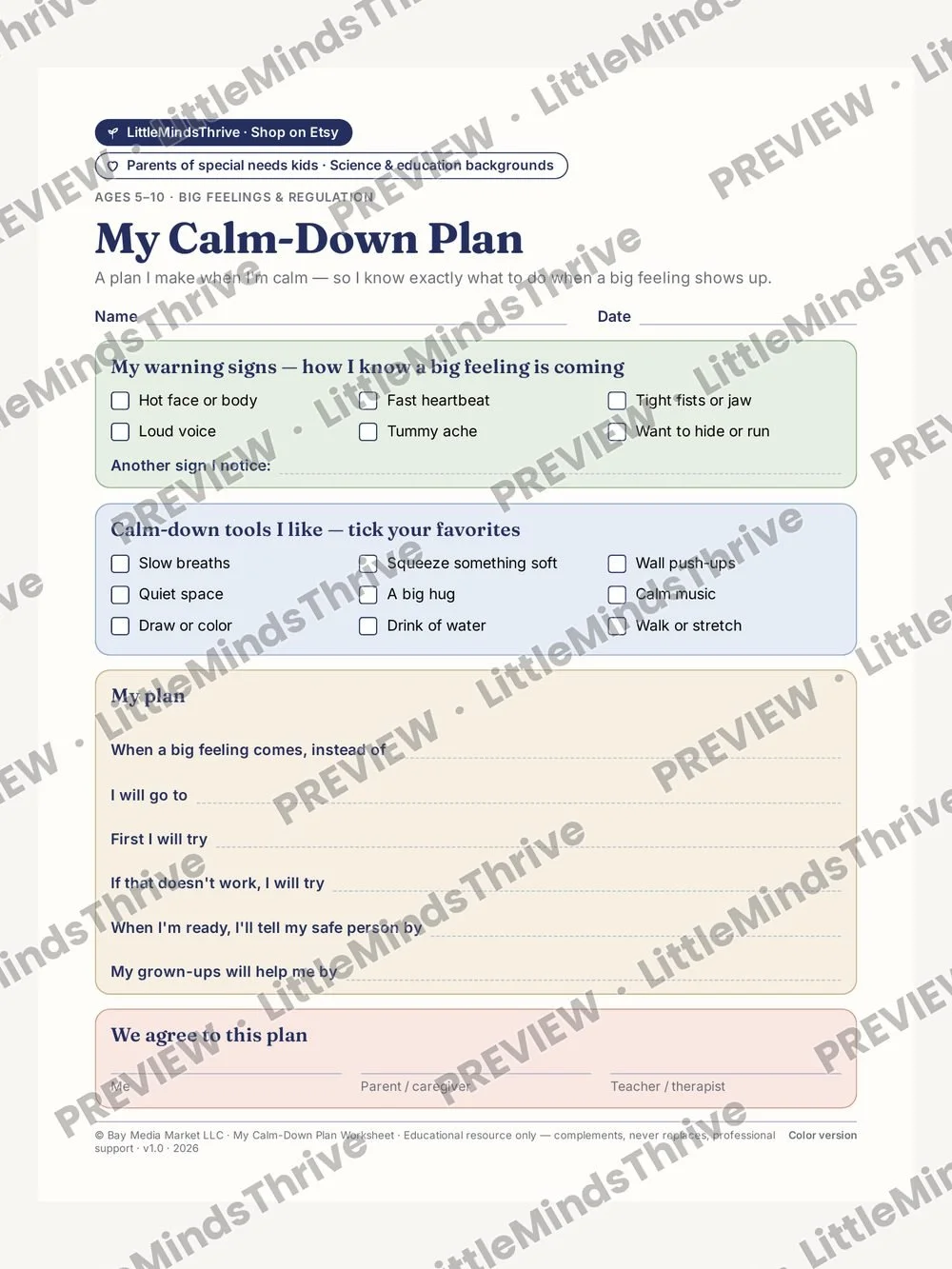
My Calm-Down Plan
Feelings Vocabulary Cards — cut-out format
Big Feelings Body Map
For Parents & Caregivers Guide
Therapist Session & Tracking Log
References — peer-reviewed citations
And more
Built for:
Parents of children with autism, ADHD, anxiety or sensory differences
Occupational therapists and BCBAs
School counselors and classroom teachers
Child psychologists and play therapists
Any caregiver who wants to help a child understand their emotions
What the Research Says
"Emotional literacy — the ability to identify, name, and understand feelings — is one of the strongest predictors of long-term social and academic success." — Greenberg et al. (1995); Gottman, Katz & Hooven (1996)
What You Get
15 Print-Ready Pages US Letter size (8.5×11in). Print at home or at a copy shop.
Instant Digital Download PDF delivered to your inbox the moment you purchase.
Use Again & Again Key pages designed to laminate for repeated dry-erase use.
Important Notes
Ages 6–10
Peer-reviewed evidence base — full bibliography included
AAC compatible — all emoji and face symbols work with PCS, Widgit and PECS
Download link active for 24 hours — save your file immediately after downloading
Educational resource only — not a substitute for professional therapy or clinical assessment
© Bay Media Market LLC — licensed for personal and single-practitioner use only
One purchase. Instant access. A toolkit that grows with your child.
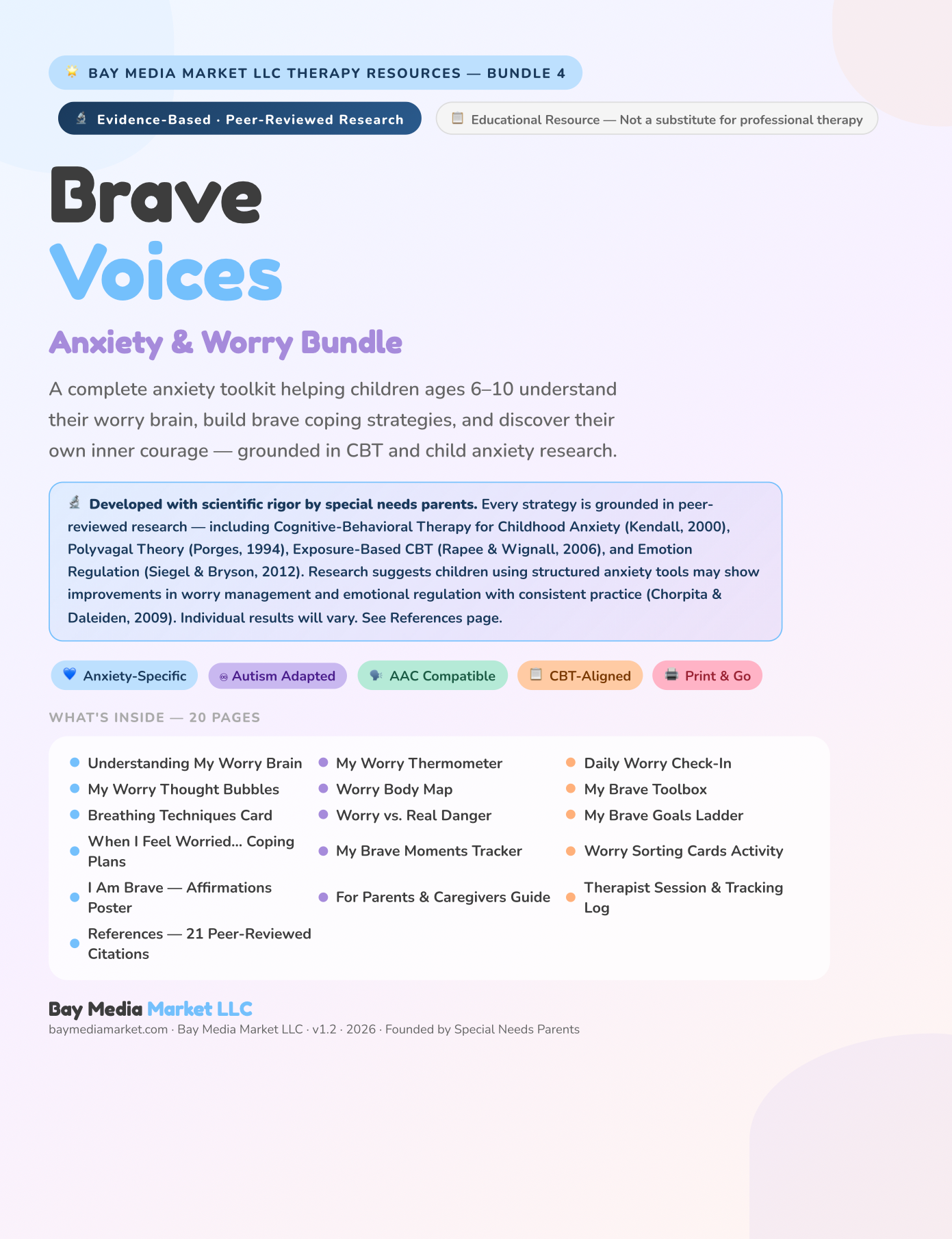
Brave doesn't mean not scared. It means doing it anyway.
A complete anxiety and worry toolkit for children ages 6–10.
Anxiety in children looks different from anxiety in adults. It looks like meltdowns, refusals, stomach aches, and clinging. It looks like a child who desperately wants to join in but can't make their body do it.
We built Brave Voices because our children needed more than reassurance — they needed tools. Every page is grounded in CBT and exposure therapy research by Kendall, Rapee, and March & Mulle, and reviewed by occupational therapists and child psychologists.
What’s Inside
20 pages covering:
Understanding My Worry Brain — how anxiety works
My Worry Thermometer — 10-level scale, laminate for daily use
Daily Check-In — print one per week
Worry Thought Bubbles — cognitive reframing worksheet
My Worry Body Map — where do I feel it?
My Brave Toolbox — personalized coping strategy bank
Breathing Techniques — 5 illustrated techniques, laminate
Worry vs. Real Danger — sorting activity
My Brave Goals Ladder — gradual exposure hierarchy
Coping Plans — 3 personalized situation plans
Brave Moments Tracker — weekly stars, print one per week
Worry Sorting Activity & Cut-Out Cards — two-page set
Affirmations Poster — I Am Brave
For Parents & Caregivers Guide
Therapist Session & Tracking Log
References — 21 peer-reviewed citations
And more
Who It's For
Parents of children with anxiety, worry or school refusal
Occupational therapists and child psychologists
School counselors supporting anxious children
BCBAs working on anxiety-related behavioral goals
Any caregiver who wants to help a child face their fears
What the Research Says
"Gradual exposure — facing fears in small, manageable steps — is the single most effective evidence-based intervention for childhood anxiety." — Kendall (2000); Rapee & Wignall (2006); Walkup et al. (2008)
What You Get
20 Print-Ready Pages US Letter size. Key pages designed to laminate for repeated use.
Instant Digital Download PDF delivered to your inbox the moment you purchase.
Gradual Exposure Built In The Brave Goals Ladder follows the gold-standard CBT exposure model.
Important Notes
Ages 6–10
21 peer-reviewed citations — full bibliography included
AAC compatible throughout
Download link active for 24 hours — save immediately
Educational resource only — not a substitute for professional therapy
© Bay Media Market LLC — personal and single-practitioner use only
Every brave moment starts somewhere. This is where.
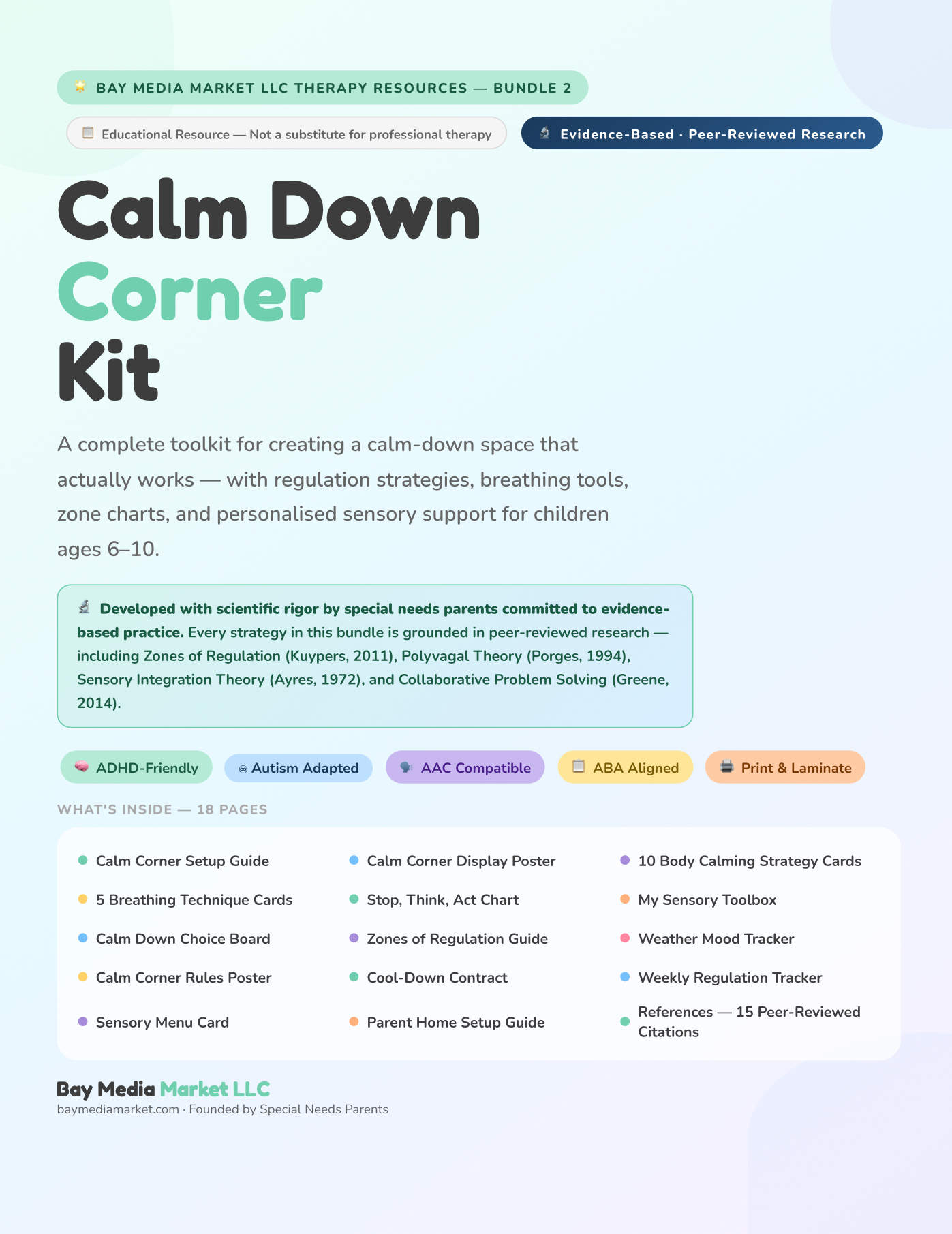
Every child deserves a place to land.
A complete calm-down corner toolkit for children ages 6–10
We know what it looks like when a child hits their limit and there's nowhere safe to go. The Calm Down Corner Kit was built to change that — giving children a designated, predictable space where big feelings can land without shame, consequence, or judgment.
Every page is grounded in peer-reviewed regulation research and reviewed by occupational therapists and child psychologists. Not a time-out. A toolkit.
What’s Inside
18 pages covering:
How to Set Up a Calm Down Corner — therapist guide
My Feelings Thermometer — laminate for daily use
My Zones of Regulation — visual reference poster
Calm-Down Strategy Cards — cut-out format
My Breathing Techniques — 5 illustrated techniques
My Calm-Down Toolbox — personalized strategy planner
Body Scan Worksheet — where do I feel it?
My Calm-Down Plan — step-by-step personal plan
Feelings Check-In — print one per week
My Cool-Down Contract — signed by child & adults
Progress Tracker — weekly stars
For Parents & Caregivers Guide
Therapist Session & Tracking Log
References — peer-reviewed citations
And more
Built for:
Parents setting up a calm corner at home
Occupational therapists and school counselors
Classroom teachers supporting regulation in class
BCBAs working on emotional regulation goals
Any caregiver supporting a child through big feelings
What the Research Says
"Children with access to a structured calm-down space show reduced meltdown frequency and duration within 4–6 weeks of consistent use." — Kuypers (2011); Porges (1994); Greene (2014)
What You Get
17 Print-Ready Pages US Letter size (8.5×11in). Print at home, laminate key pages for repeated use.
Instant Digital Download PDF delivered to your inbox the moment you purchase.
Home & School Versions - Key pages include both home and classroom versions.
Important Notes
Ages 6–10
Peer-reviewed evidence base — full bibliography included
AAC compatible throughout
Download link active for 24 hours — save your file immediately after downloading
Educational resource only — not a substitute for professional therapy or clinical assessment
© Bay Media Market LLC — licensed for personal and single-practitioner use only
One purchase. Instant access. A toolkit that grows with your child.
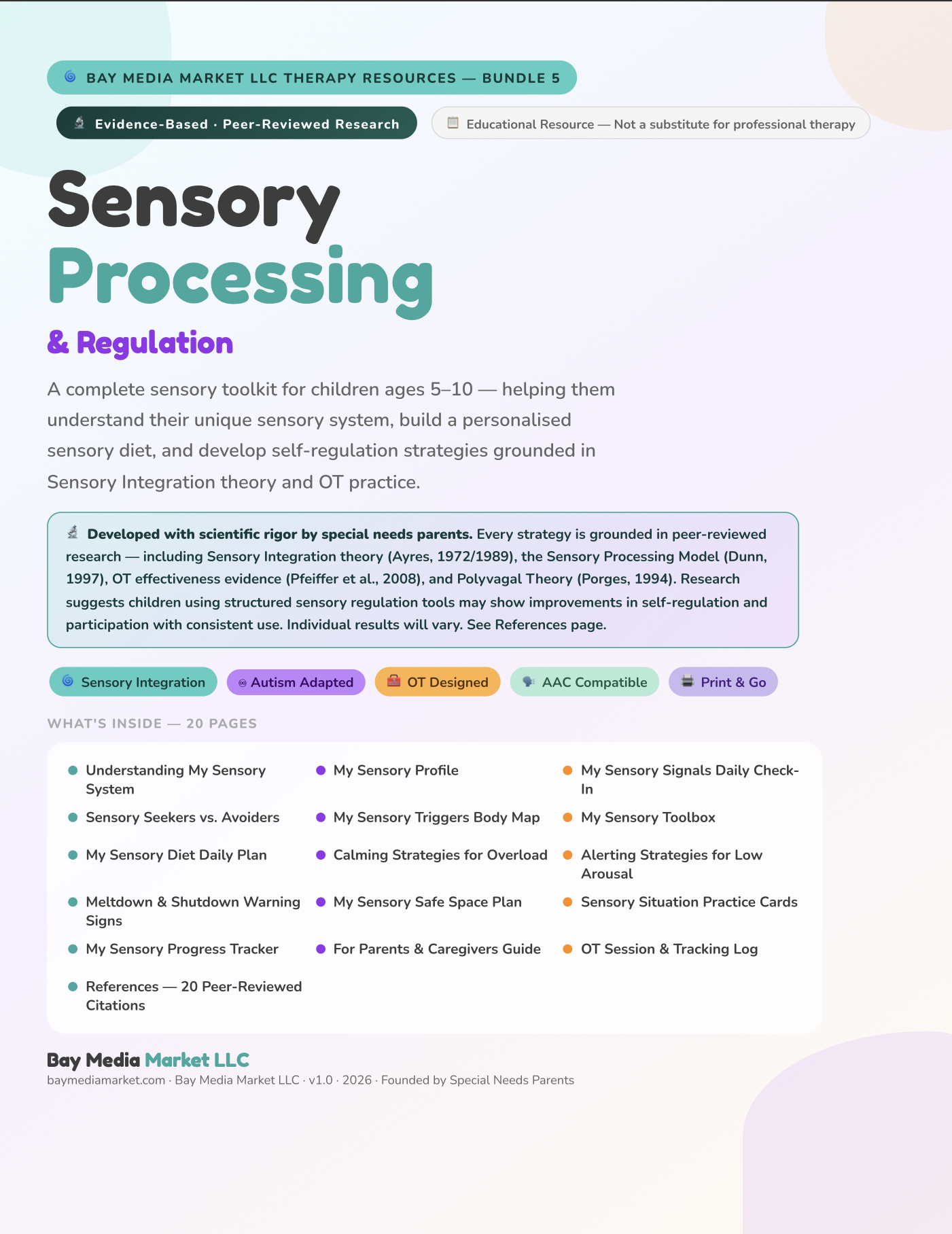
Their brain isn't broken. It's just louder than most.
A complete sensory processing and regulation toolkit for children ages 5–10.
When your child covers their ears at sounds no one else notices, refuses food textures, crashes into furniture, or shuts down completely in busy environments — they're not being difficult. Their sensory system is working differently from most.
We built this bundle because our children needed tools that matched how their nervous system actually works. Every strategy is grounded in Sensory Integration theory by Ayres, Dunn's Sensory Processing Model, and OT effectiveness research, and reviewed by occupational therapists and child psychologists.
What’s Inside
20 Pages covering:
- Understanding My Sensory System — all 8 senses explained
My Sensory Profile — personalised overresponsive/underresponsive map
My Sensory Signals Daily Check-In — print one per week
Sensory Seekers vs. Sensory Avoiders — which am I?
My Sensory Triggers Body Map — SVG illustrated figure
My Sensory Toolbox — heavy work, deep pressure, movement & more
My Sensory Diet Daily Plan — OT-designed morning to bedtime structure
Calming Strategies for Overload — 5-step plan, laminate for calm corner
Alerting Strategies for Low Arousal — when the body feels switched off
Meltdown vs. Shutdown Warning Signs — side-by-side guide
My Sensory Safe Space Plan — home AND school versions
Sensory Situation Practice Cards — cut-out scenario cards
My Sensory Progress Tracker — print one per week
For Parents & Caregivers Guide
OT Session & Tracking Log
References — 20 peer-reviewed citations
And more
Who It’s For
Parents of children with sensory processing differences
Occupational therapists building sensory diets
BCBAs working with children with autism or SPD
School counselors and special education teachers
Any caregiver supporting a child through sensory overload or shutdown
What the Research Says
"A personalised sensory diet — a schedule of sensory activities woven into a child's daily routine — is one of the most effective tools for maintaining an optimal arousal level for learning and participation." — Wilbarger & Wilbarger (1991); Ayres (1989); Schaaf & Mailloux (2015)
What You Get
20 Print-Ready Pages US Letter size. Multiple pages designed to laminate for daily use.
Instant Digital Download PDF delivered to your inbox the moment you purchase.
All 8 Senses Covered Including interoception — the most overlooked sense in children's resources.
Important Notes
Ages 5–10 — the youngest entry point in the BMM series
20 peer-reviewed citations — full bibliography included
OT-designed sensory diet framework
Download link active for 24 hours — save immediately
Educational resource only — not a substitute for OT assessment or treatment
© Bay Media Market LLC — personal and single-practitioner use only
Understanding their sensory system is the first step to helping them thrive.
Your child isn't trying to be difficult.
Their brain just works differently.
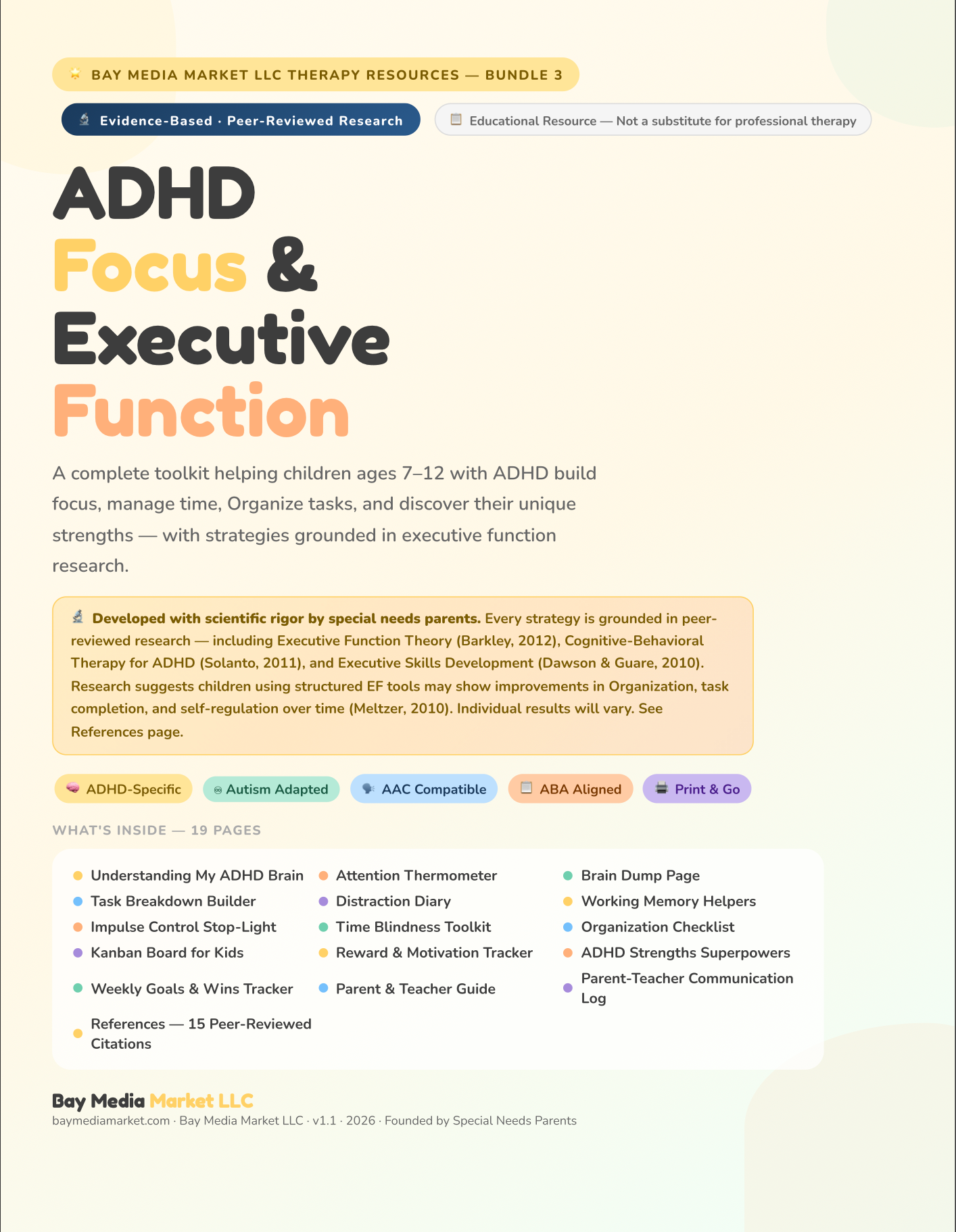
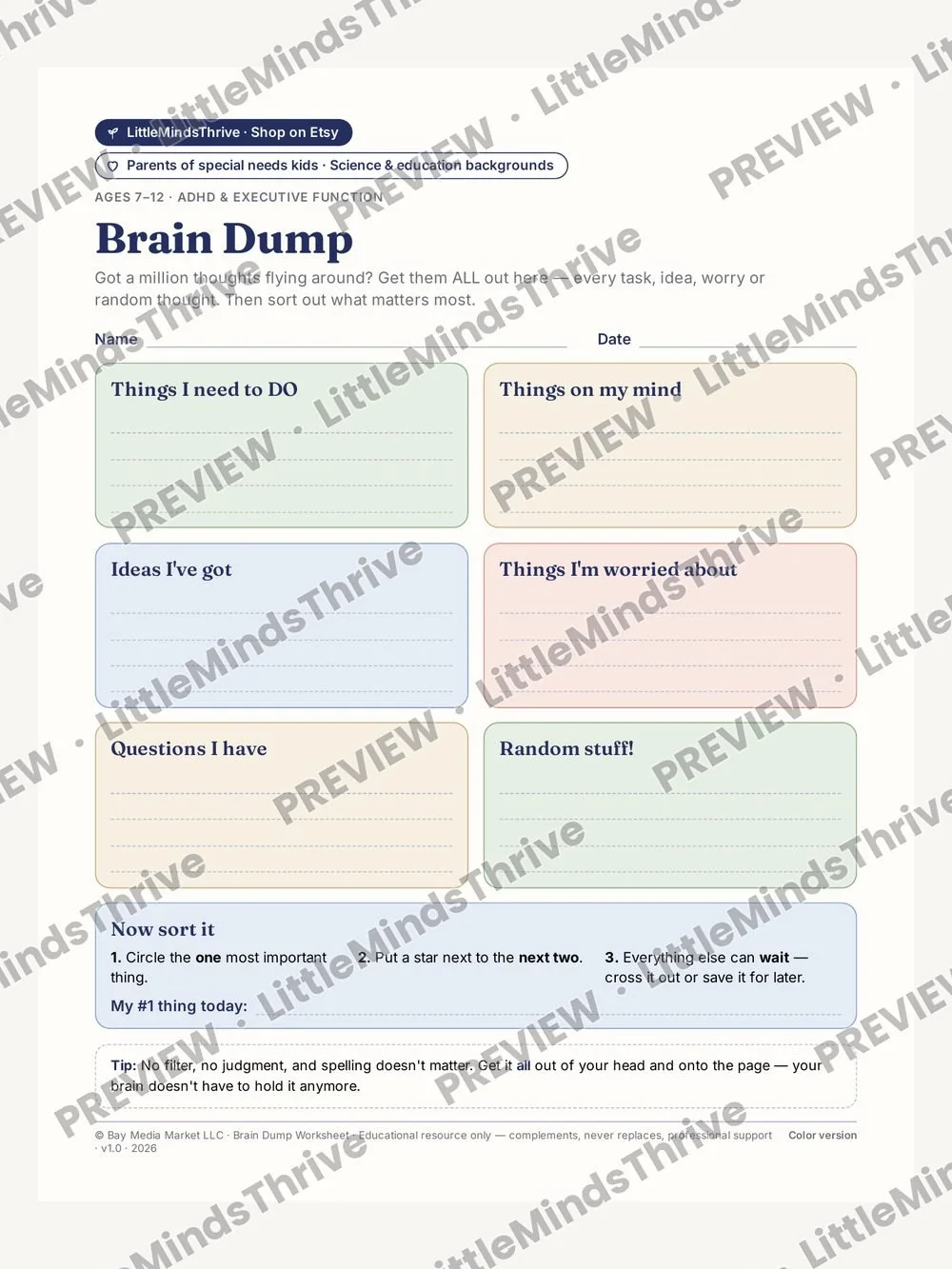
A complete ADHD and executive function toolkit for children ages 7–12.
ADHD is not a behaviour problem. It's a neurological difference in how the brain manages attention, impulse control, time, and planning. We built this bundle because our children needed tools that worked WITH their brain — not against it.
Every strategy is grounded in executive function research by Barkley, Dawson & Guare, and Hallowell & Ratey, and reviewed by occupational therapists and child psychologists. Strengths-based. Evidence-backed. Actually usable.
What’s Inside
19 pages covering:
Understanding My ADHD Brain — child-facing explainer
My Attention Thermometer — 5-level arousal scale
My Focus Toolkit — personalised strategy bank
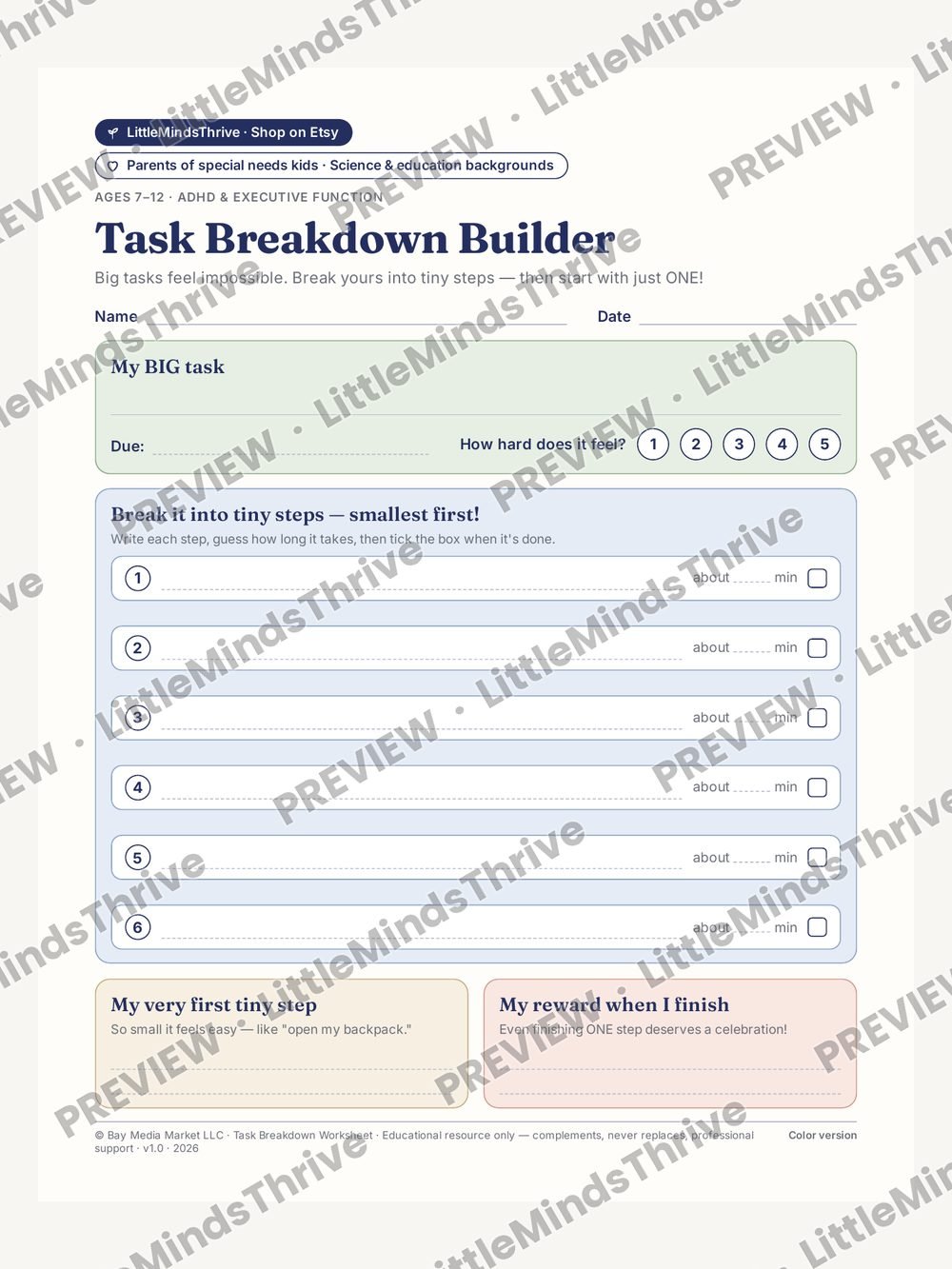
Task Breakdown Planner — chunking for big tasks
My Daily Schedule — visual structure tool
Homework Survival Kit — step-by-step routine
My Distraction Busters — what pulls me off task
Brain Break Activities — movement & reset strategies
My ADHD Strengths — strengths-based self-portrait
Emotion Regulation for ADHD — body + brain connection
Weekly Goals & Wins Tracker
For Parents & Caregivers Guide
Therapist / Teacher Session & Tracking Log
References — peer-reviewed citations
And more
Who It's For
Parents of children with ADHD or executive function difficulties
Occupational therapists and BCBAs
School counselors and special education teachers
Child psychologists working on EF goals
Any adult supporting a child who struggles with focus, organization or impulse control
What the Research Says
"ADHD is fundamentally a disorder of self-regulation — not attention. Children with ADHD have the ability to pay attention. They struggle to regulate when and how they deploy it." — Barkley (2012).
What You Get
19 Print-Ready Pages US Letter size. Key pages designed to laminate for repeated use.
Instant Digital Download PDF delivered to your inbox the moment you purchase.
Strengths-Based Throughout Every page frames ADHD as a difference, not a deficit.
Important Notes
Ages 7–12
Peer-reviewed evidence base — full bibliography included
Covers both inattentive and hyperactive/combined presentations
Download link active for 24 hours — save immediately
Educational resource only — not a substitute for professional assessment
© Bay Media Market LLC — personal and single-practitioner use only
Built for the brain your child actually has.
Social skills aren't innate. They're learned. And they can be taught.
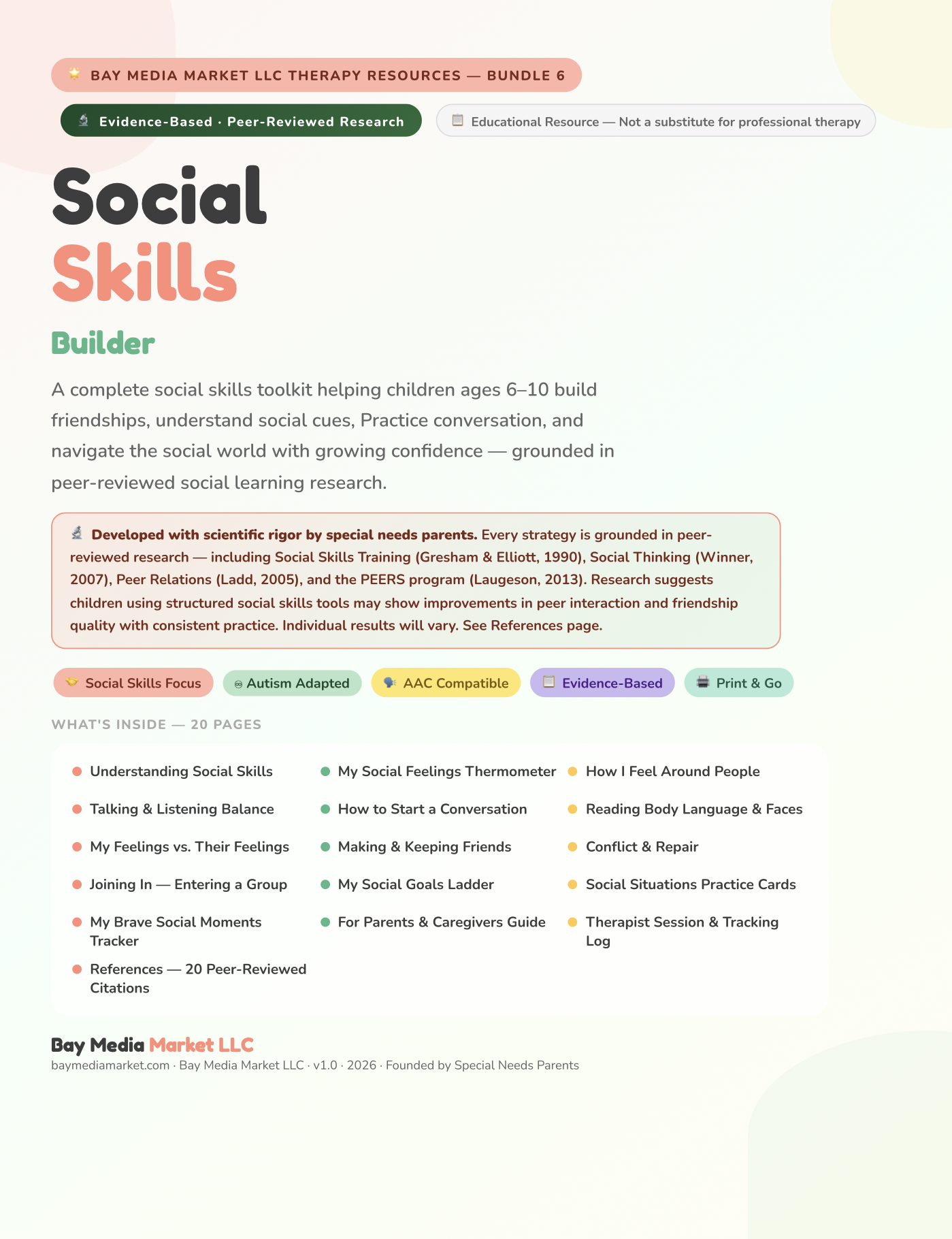
A complete social skills toolkit for children ages 6–10.
For children with autism, ADHD, anxiety, or social communication differences, the unwritten rules of social interaction can feel invisible and impossible. They want to connect. They just need someone to show them how.
We built the Social Skills Builder because our children needed more than advice — they needed a step-by-step framework. Every page is grounded in social learning research by Gresham & Elliott, Laugeson's PEERS programme, and Winner's Social Thinking model, and reviewed by occupational therapists and child psychologists.
What’s Inside
20 pages covering:
Understanding Social Skills — what they are and how they're learned
My Social Feelings Thermometer — laminate for daily use
How I Feel Around People Daily Check-In — print one per week
Talking & Listening Balance — the conversation catch game
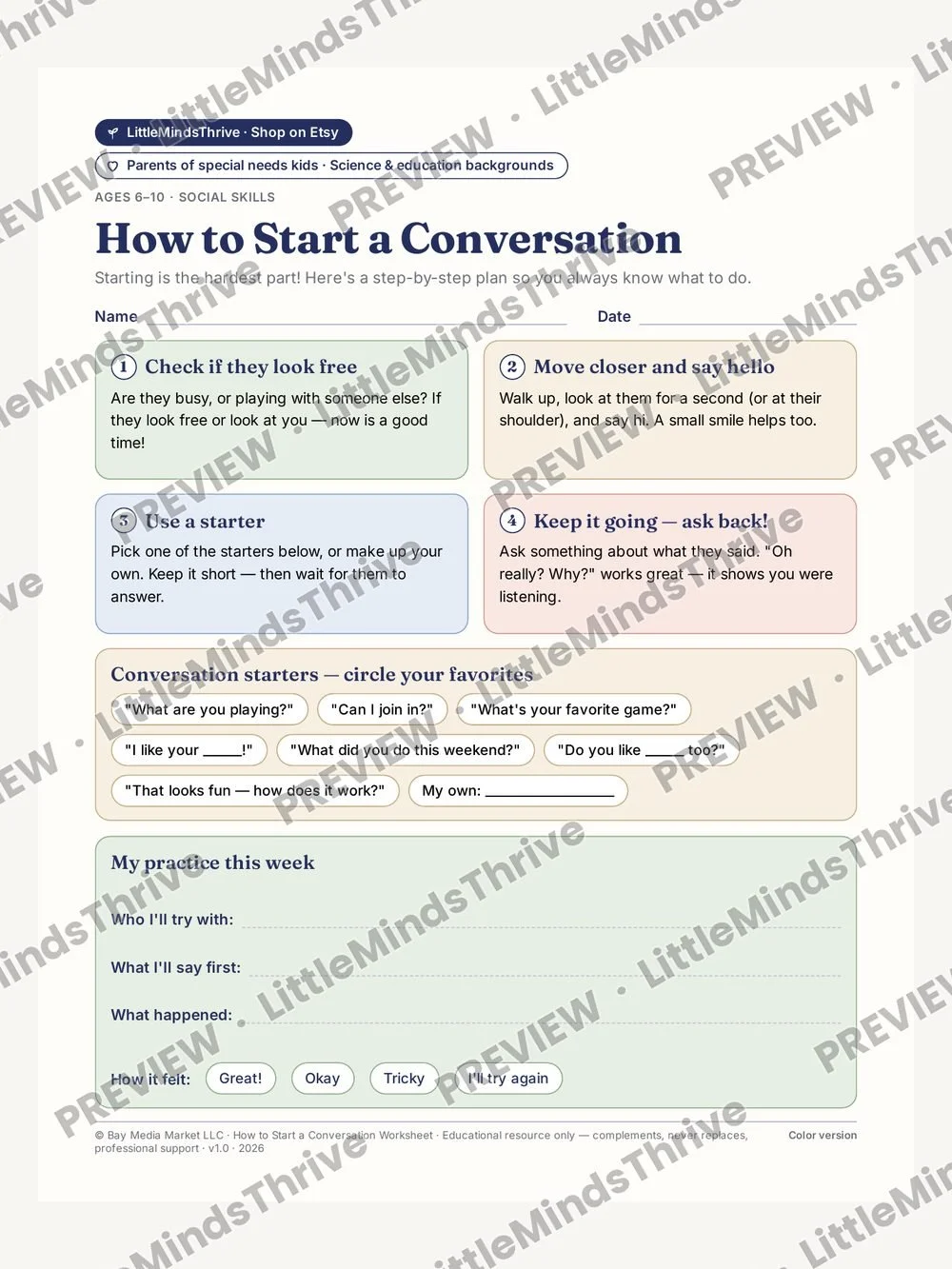
How to Start a Conversation — 4-step guide and starter phrases
Reading the Room — 8 illustrated facial expressions
My Feelings vs. Their Feelings — perspective-taking worksheet
Making & Keeping Friends — friendship recipe and qualities
Conflict & Repair — 5-step resolution process
Joining In — how to enter a group, watch-and-wait strategy
My Social Goals Ladder — gradual exposure for social situations
Social Situations Practice Cards — cut-out scenario cards
My Brave Social Moments Tracker — print one per week
For Parents & Caregivers Guide
Therapist Session & Tracking Log
References — 20 peer-reviewed citations
And more
Who It’s For
Parents of children with autism, ADHD, or social communication differences
Occupational therapists and BCBAs working on social goals
School counselors supporting peer relationships
Speech and language therapists
Any caregiver helping a child navigate friendships and social situations
What the Research Says
"Social competence develops through observation, modelling, and repeated practice — not through instruction alone. Children learn best by watching, role-playing, and then trying in real situations with support." — Bandura (1977); Laugeson (2013); Gresham & Elliott (1990)
What You Get
20 Print-Ready Pages US Letter size. Key pages designed to laminate for repeated use.
Instant Digital Download PDF delivered to your inbox the moment you purchase.
Role-Play Ready Every page is designed for therapist-guided role-play before real-world practice.
Important Notes
Ages 6–10
20 peer-reviewed citations — full bibliography included
AAC compatible — all emoji and face symbols work with standard AAC sets
Download link active for 24 hours — save immediately
Educational resource only — not a substitute for professional therapy
© Bay Media Market LLC — personal and single-practitioner use only
Help your child's new teacher understand them from day one.
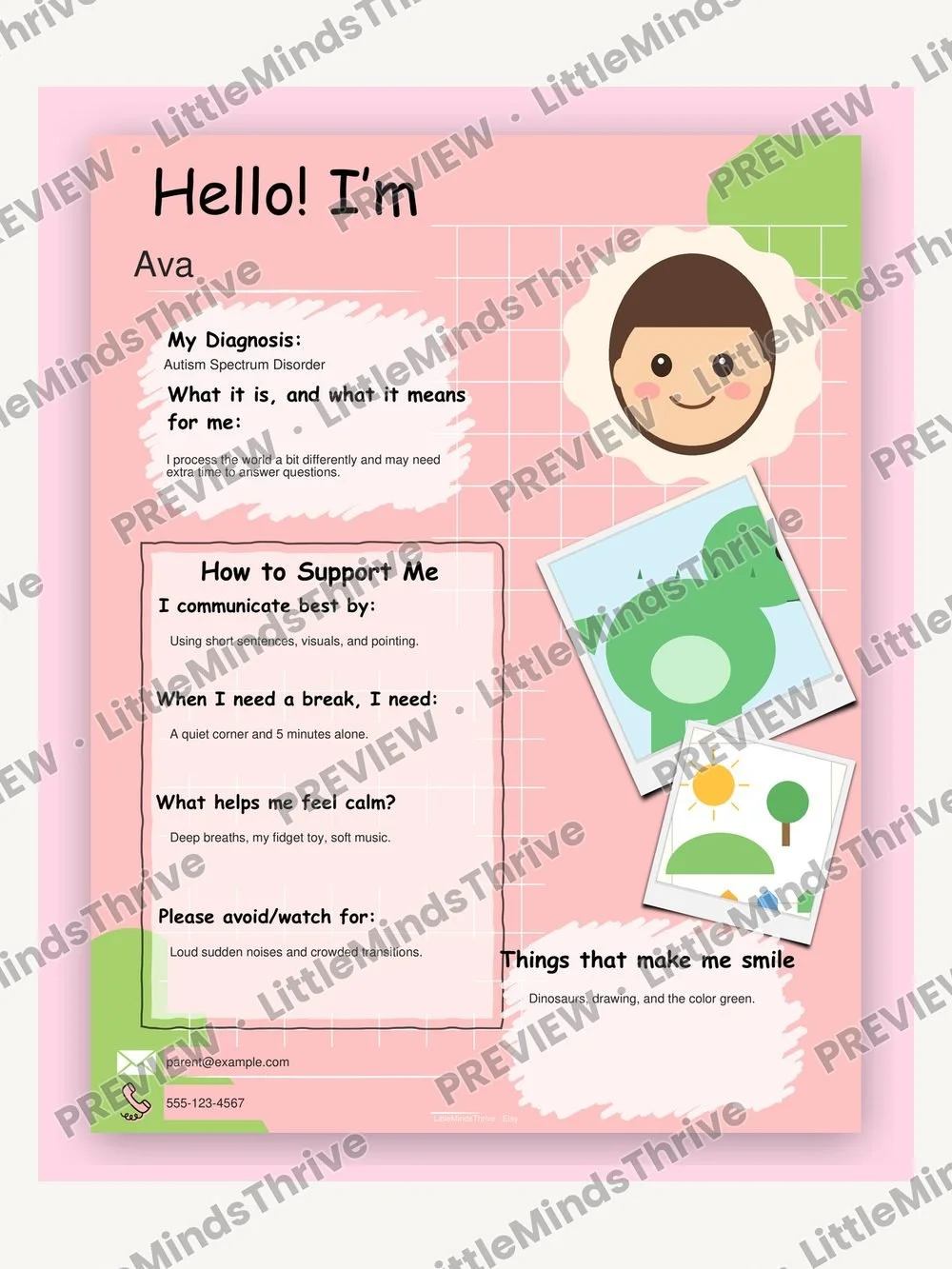
A fillable one-page "All About Me" profile — Blue edition
This fillable PDF gives teachers, aides and substitutes the essentials in one warm, easy-to-scan page: your child's diagnosis, how to support them (communication style, break needs, calming strategies and triggers to watch for), their favorite things, and space for 3 photos.
Prefer pink? The Pink edition is available too.
How It Works
Download the PDF instantly after purchase
Open in Adobe Acrobat Reader (free) or Apple Preview
Click into any field and type — text wraps automatically
Print at home or at a copy shop, or share it with the teacher digitally
Printing tip: print at 100% / "Actual Size" in Best or Photo quality, on cardstock if you can
Built for
Parents preparing for a new school year, new teacher or substitute
IEP and 504 meetings, aides, therapists and caregivers
Children with autism, ADHD, sensory or communication needs
What You Get
1 fillable PDF page in a bright blue colorway
Fields for: name, diagnosis and what it means for them, communication style, break needs, calming strategies, things to avoid/watch for, favorites, and parent contact info
US Letter (8.5 × 11 in)
Instant digital download
Important Notes
Not a medical or legal document — it doesn't replace an IEP, 504 plan, or guidance from your child's care team
Download link active for 24 hours — save immediately. Expired? Check your email for a new link.
© Bay Media Market LLC — licensed for personal use only; please don't resell or share the file